A free standing cold water humidifier was linked to a
Legionella (Lp1) infection in an infant that had for six weeks also been
receiving corticosteroid treatment for shortness of breath and wheezing. The
humidifier had been filled with tap water and not regularly cleaned. The infant
was admitted to the hospital in February this year due to high fever, cough,
wheezing, and vomiting, and died two weeks later despite antibiotic treatment.
The report is posted at http://www.eurosurveillance.org/ViewArticle.aspx?ArticleId=20293.
24 de out. de 2012

15 de out. de 2012
Legionnaires' disease found in water at Seneca Towers

Legionnaires’ disease bacteria have been found in the water at the Seneca Towers apartment complex, apparently leading to at least two known cases of the illness.
Residents at the high-rise apartment building at 200 Seth Green Drive have been told not to use the water because of the positive testing.
“To reduce potential health risks to residents,” said Jeffrey Hammond, a spokesman for the New York State Department of Health, “the facility has implemented infection control measures on the recommendation of the state and county health departments, which include a number of water-use restrictions.”
obs: Este caso como muitos outros, indica que podemos ter problemas com a Legionella em qualquer ambiente, inclusive em nossa própria casa.
10 de out. de 2012
4 de out. de 2012
Risk Assessment Legionella - Uruguay, Argentina e Chile
A SETRI passa a atender com seus serviços de Avaliação de Risco (Risk Assessment) para Legionella, Water Safety Plan e Indoor Air Quality os paises: Uruguay, Argentina e Chile.
Com isso estamos levando aos paises da America Latina todo nosso conhecimento nos temas.

Com isso estamos levando aos paises da America Latina todo nosso conhecimento nos temas.

27 de set. de 2012
Palestra sobre a bactéria Legionella - Brasindoor

Prof. Dr. Dario com o Dr. Szymon da Covisa durante a paletra


Dr.Gustavo e Prof. Dr. Dario após palestra sobre a Legionella
Paletra sobre Legionella - Prof. Dr. Dario Zamboni

A paletra do Dr Dario (Universidade São Paulo - Faculdade de Medicina Ribeirão Preto), um dos maiores especialistas sobre pesquisa da bactéria Legionella, foi um sucesso no dia de hoje no Congresso da Brasindoor.
Tudo que estamos falando a muito tempo sobre a bactéria Legionella foi apresentado pelo Prof. Dr. Dario.
26 de set. de 2012
Alguns casos de Legionella
Blaines, Spain, Sept. 2012
As of late September, a total of 11 males and 3 females ranging from 47 to 82 years of age have contracted Legionnaires' in Blaines, Spain. Several patients were hospitalized but responded well to treatment.
Major Outbreak in Quebec City, July-Sept 2012
A total of 180 people contracted Legionnaires' disease from July through mid September, 13 of whom have died. A cooling tower at an office building was declared by authorities to be the source of the outbreak based on finding identical Legionella strains in the tower and several patients.
Chicago hotel, July-Aug 2012
Ten people who visited or stayed at a downtown Chicago hotel between mid-July and mid-August contracted Legionnaires' disease, three of whom have since died. A decorative fountain in the hotel's main lobby is the suspected source.
Stoke-on-Trent, England, hot tub, 19 cases, July 2012
Investigators believe that a hot tub in a store is the probable source of a Legionnaires' outbreak in Stoke-on-Trent based on water test results and epidemiologic evidence. As of today, 19 cases have been confirmed, 8 patients are still hospitalized, and one person has died.
Major outbreak in Scotland, May-July 2012
Between the end of May and mid July, a total of 101 confirmed or suspected cases of Legionnaires' disease were identified in Edinburgh. Three men who had underlying health conditions have died. The investigators suspected a cooling tower in a densely populated area of the city but have not been able to confirm a source.
Restaurant in Spain, 25 cases, June 2012
Based on epidemiologic evidence, investigators determined a restaurant in Mostoles (near Madrid) to be the probable source of 12 confirmed and 13 possible cases of Legionnaires' disease that occurred in late June. The 18 men and 7 women ranged from 35 to 87 years of age. The restaurant was allowed by authorities to remain open for business. The report did not mention a suspected water system.
Auckland, New Zealand, 16 Cases, Feb-May 2012
Sixteen cases of Legionnaires' disease have been identified in Auckland, New Zealand since late February. Two persons have died, both of whom had underlying illness. Because the outbreak was widely dispersed and the investigators had no obvious links, the Auckland Regional Public Health Service issued a press release asking operators of commercial and industrial buildings to shock dose cooling towers. More than 600 cooling towers were disinfected. A definite link between cooling towers and the outbreak has not been established.
Hotel in Spain, 14 Cases, 3 Deaths, Jan-Feb 2012
A four-star hotel in Calpe was temporarily closed and its water systems disinfected after Legionnaires' disease was reported in several guests. A total of 14 cases have been identified. At least nine persons were hospitalized and three have died. The deaths occurred on January 26 and 31 and February 2.
Hotel in Albany, NY, 6 Cases, Sept-Dec 2011
Laboratory tests confirmed Legionnaires' disease in six persons who had stayed at the same hotel in Albany, NY between September and December. All six have recovered. Legionella was found in the hotel's plumbing system, which was to be flushed on February 5th. An additional two cases were identified in guests who stayed at the same hotel in May 2012. The hotel voluntarily closed after those cases were reported.
Hotel in Las Vegas, 3 Cases, 2011 and 2012
Legionnaires' disease was confirmed in three people who stayed at a resort in Las Vegas. The first two cases were reported in Spring 2011; both recovered. The third case, reported January 2012, has died. According to the Southern Nevada Health District, Legionella was not found in water samples collected after the first two cases were reported but was found in samples tested last month. A hotel spokesperson said the water systems were superheated and hyperchlorinated immediately after the water test results were reported. Sources: 8newsnow.com and huffingtonpost.com
Travelers to Greece, 9 cases, Aug.-Oct. 2011 Nine cases of LD have been identified in the UK among people who had traveled to the Greek island Corfu since August. UK and Greek public health officials are investigating potential sources in both the UK and Corfu.
Pittsburgh nursing homes, 10 cases, Sept. 2011 In September the Allegheny County (Pennsylvania) Health Department initiated an investigation of the domestic water systems in two nursing homes where a total of 10 cases of Legionnaires' disease were identified. Three of the cases required hospitalization but no deaths were reported. Source: pittsburghlive.com.
Hotel in Ocean City, MD, 3 cases, Sept. 2011
A hotel in Ocean City, Maryland relocated its guests to other Ocean City hotels and closed early for the season, on September 29th, after the Maryland Department of Health and Mental Hygiene (DHMH) reported three cases of Legionnaires' disease among people who had stayed there. Each of the three cases developed Legionnaires' symptoms about a week after their stay at the hotel and were hospitalized.
Hamilton, Ontario, 4 cases, Aug.-Sept. 2011Health officials are investigating four cases of Legionnaires' disease, the first of which was reported in mid August and the other three since Sept. 22, to determine whether there is a common source. The investigators focused on cooling towers located on the east side of the city. Source: thespec.com
UK hospital, Aug. 2011
In August the UK's Health and Safety Executive, as well as the police, investigated a fatal case of Legionnaires' disease that occurred in a patient of an Essex hospital where three other patients died from Legionella infections in the last nine years. Three cases were identified at the hospital in 2010, one of which was fatal. The hospital said that it has been disinfecting and monitoring its plumbing system since the first case of Legionnaires' was identified there in 2002. Sources: basildonrecorder.co.uk and bbc.co.uk
Travelers to Italy, 17 cases, July-Aug. 2011
Seventeen cases of Legionnaires' disease were reported in travelers who stayed at two campsites and three hotels in Lazise, Italy between early July and the end of August. Their ages ranged from 42 to 78 years. Sixteen of the cases were confirmed by urinary antigen tests. None of the cases resulted in death. The cases were discovered through the European Legionnaires' Disease Surveillance Network (ELDSNet).
Shredding plant workers, July 2011
The National Institute for Occupational Safety and Health (NIOSH) recently investigated five cases of Legionnaires' Disease in workers at a shredding plant in upstate New York. The last of the five cases was identified in July. Legionella was found in water samples collected from several pools of standing water, in water dripping from the shredder (Water is used for cooling and lubrication in the shredders.), and on swabs of a conveyor belt. The investigators believed that standing water was the source of contamination. All the workers who were Legionella-positive worked around standing water or near a conveyor. The NIOSH report, dated July 22, 2011, recommended that all standing water be eliminated in the facility and on the grounds, that workers in the areas where cases occurred wear respirators, and that conveyors be disinfected with chlorine. Source: Times-Shamrock
Las Vegas hotel, July 2011Legionnaires' disease was reported in guests of a hotel on the Las Vegas strip this month. Health officials investigated the same hotel last year after reports of the disease. Legionella was found in the hot water system in several guest rooms.
Cleveland nursing home, 3 cases, June 2011
Three residents of a Cleveland nursing and rehab facility were hospitalized with Legionnaires' disease in June. The facility provided bottled drinking water and restricted showers until the water system was disinfected. Source: cleveland.com
New Zealand, 3 cases, April 2011 Three New Zealand men who worked near one another contracted Legionnaires' disease in April. Health officials focused their investigation on cooling towers. Source: radionz.co.nz
Hotel in Scotland, Mar. 2011
A hotel in Scotland closed its an indoor heated pool and spa and other "leisure club" facilities in March after employees and guests reported flu-like symptoms. One person was hospitalized with confirmed Legionnaires' disease. In all, 112 people contracted a flu-like illness with respiratory infection.
Playboy mansion, Feb. 2011
According to the Los Angeles County Health Department, about 200 people who attended a February 3rd fundraiser at the Playboy Mansion were infected by Legionella bacteria. Four of them contracted Legionnaires' disease; the rest had Pontiac fever, a flu-like illness that lasts about three days. News reports mentioned a fog machine at the event. [Pontiac fever has a much higher attack rate than does Legionnaires' disease, > 90% as opposed to < 5%, and a shorter incubation period, usually 6-48 hours as opposed to 2-14 days. -- mrf]
Ohio hospital, 4 cases, Feb. 2011 Four heart patients of a new hospital in Ohio were diagnosed with confirmed Legionnaires' disease this month, three of whom have been discharged. The hospital is investigating the plumbing system in its new patient tower, which began admitting patients in late December.
Eye clinic in UK, 3 cases, Jan. 2011 An outpatient eye clinic operated at a hospital in the UK was closed for the first three weeks of this year after a staff member and two of its patients were diagnosed with Legionnaires' disease. The results of the investigation were not reported. Source: Ealing Gazette
Hotels in Virgin Islands, March 2010-Aug 2011
It was announced in December that the Centers for Disease Control and Prevention (CDC) linked five Legionnaires' disease cases reported between March 2010 and August 2011 to two hotels in Saint Thomas. All five persons required hospitalization but recovered.
25 de set. de 2012

19 de set. de 2012
Legionnaires Disease Outbreak in PA Puts Hotel Guests at Risk
At a hotel in Grantville, one person and possibly more have been infected by bacteria that cause the deadly Legionnaires’ disease. A source at the Pennsylvania Department of Health is confident that recent guests who may have been exposed to Legionella bacteria have been notified and that “… there is no reason to believe there is a general risk to the community.”
People with Legionnaires’ disease, also known as Legionellosis, are generally infected after inhaling airborne particles containing the bacteria. When large water systems are poorly maintained, Legionella can quickly breed and contaminate components such as faucets and showers or even hot tubs and central air conditioning systems. Though the bacteria can be detected with a simple water test, many buildings have not implemented testing guidelines.
Up to 30 percent of Legionnaires’ disease can result in death according to the Centers for Disease Control. When antibiotic treatment is delayed, fatalities can reach up to 50 percent.
18 de set. de 2012
Legionella - Dentistas
Primary Care Dentists & Legionella Control

Second Element provides vital advice and control measures to ensure the health and safety of dental staff and patients by controlling legionella bacteria within dental unit water lines.
Richard Danielson, Director of Second Element, said research at the Centre for Applied Microbiology and Research, Porton Down, showed that of 55 water samples from dental surgeries in the south-west of England, 52 samples failed the European Union drinking-water safety standards.
Water lines were found to contain bacteria including legionella. Oral streptococci, normally present in the oral cavity, was found in 10% of the samples tested. Studies have shown that up to 25% cent of DUWLs are contaminated with legionella and 95% of water in general dental practice DUWLs fails current EU potable-water guidelines on microbial load.
Legionella bacteria can be transmitted to dental staff and patients by inhalation of contaminated water droplets or aerosol generated by water-cooled high speed dental instruments. It is therefore essential to ensure that the water used during dental procedures is of a quality that does not pose any threat or risk to health to either staff or the patient.
All dental practices must perform a legionella risk assessment plus water quality testing performed. Each dental practice must also have a written document of procedures and measures to maintain the control of legionella. This must be devised by a competent person who can be a member of the Legionella Control Association.
17 de set. de 2012

13 de set. de 2012
Fabio Feldmann no Congresso do GBCB
Nosso encontro com o Fabio Feldmann, no Congresso do GBCB. O tema que conversamos foi sobre o "Plano de Segurança no uso da Água".
Além do tema, tivemos a oportunidade de receber do Fabio um exemplar do seu livro "Sustentabilidade Planetária, onde eu entro nisso ? ".

Além do tema, tivemos a oportunidade de receber do Fabio um exemplar do seu livro "Sustentabilidade Planetária, onde eu entro nisso ? ".

Plano de Segurança no uso da Água - Water Safety Plan
Nossa apresentação sobre o Plano de Segurança no uso da Água - Water Safety Plan, no Congresso do GBCB hoje em São Paulo.


Congresso GBCB 2012 - Sofitel Jequitimar Guarujá - Accor

Apresentação do Luis Fernando, do Hotel Sofitel Jequitimar Guarujá, foi excelente, onde o tema foi o descarte zero de água do hotel.
Foi demonstrado que as possibilidades existem e podemos sim ter sistemas realmente sustentáveis.
Além da apresentação, realizada hoje, um grupo de participantes estiveram ontem no próprio Hotel visitando as instalações para conhecer todo o processo desenvolvido.
Temos que parabenizar a grande iniciativa do Sofitel Jequitimar Guarujá.
Congresso GBCB 2012
Hoje o dia foi bem movimentado, grandes palestras e encontro com a liderança do movimento das melhores práticas para contrução e operação de edificações sustentáveis.
O Congresso sem dúvida foi um sucesso.


O Congresso sem dúvida foi um sucesso.


12 de set. de 2012
Congresso do GBCB
Mais um dia bem movimentado, excelentes palestras e encontro com grandes amigos.
O movimento do GBCB está a cada dia mais forte.


O movimento do GBCB está a cada dia mais forte.


11 de set. de 2012
Palestra do Nelson Kawakami - Congresso GBCB
O grande amigo Nelson, em sua palestra de abertura do Congresso do GBCB, faz uma homenagem as pessoas que para ele, participaram do início da jornada da construção verde no Brasil. Fiquei muito emocionado ao ver meu nome na apresentação.
Nelson, obrigado pela lembrança e nos sabemos bem como foi iniciar esta grande jornada no GBCB.
Obrigado pela lembrança e vamos continuar sempre.

Nelson, obrigado pela lembrança e nos sabemos bem como foi iniciar esta grande jornada no GBCB.
Obrigado pela lembrança e vamos continuar sempre.


7 de set. de 2012
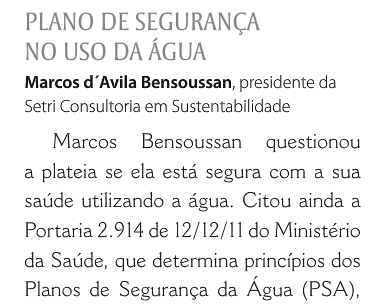
Plano de Segurança do uso da Água - PSA - Water Safety Plan

A SETRI já está trabalhando em desenvolver junto ao mercado o Plano de Segurança do uso da Água para Edificações e Indústrias.
O Water Safety Plan é de suma importância não só para projetistas, engenheiros, arquitetos como para os responsáveis de operação.
Se deseja conhecer mais sobre o tema, onsulte a SETRI pelo site www.setri.com.br
2 de set. de 2012
Legionnaires' kills 11 people in Quebec City
CBC News
Last Updated: Sep 2, 2012 1:25 PM ET
 Stagnant water in highrise cooling systems like this one is believed to be responsible for the spread of legionnaires' disease in Quebec City. (CBC)
Related
Related Stories
Quebec's public health board says legionnaires' disease has claimed one more life in Quebec City, raising to 11 the number of people who have died from complications.
As of Sunday, 169 people had been infected since July.
On Friday, the public health board said it was seeing fewer cases of infections caused by the disease.
According to authorities, the overall number of patients being admitted with the infection seems to be tapering off. The city has inspected and disinfected 130 cooling towers around the city.
On Friday, Quebec City Mayor Régis Labeaume said he wants the public health board to release the locations of buildings where officials have discovered legionella bacteria.
Labeaume has also asked regional public health director François Desbiens to maintain a high level of honesty while investigating the outbreak.
According to the public health department, many building owners have failed to respond to the government's request to inspect their cooling towers.
Quebec's Public Security Minister Robert Dutil has demanded a coroner's inquest into the matter.
The potentially deadly legionella bacteria can grow in stagnant water and then spread in droplets through ventilation.
Heavy smokers and people with weak immune systems are most at risk of catching the disease, which is not contagious. Symptoms include persistent fever, coughing and difficulty breathing. Most people are not at risk.
The disease can be treated with antibiotics if it is diagnosed in time. There has never been a documented case of drug-resistant legionella.
This order was effective as of Saturday.
Officials inspecting the cooling towers are giving owners information kits on how to maintain a level of sanitation that conform to the new standards.
In total, 130 towers in 75 establishments were inspected. Thirty-one of these were inspected twice, most of them in the Saint-Roch and Saint-Sauveur neighbourhoods.
On Friday, the organization representing Quebec's master plumbers warned that people who lower the temperature on their water-heaters to save power could be exposing themselves to the bacteria.
In a release, the organization asks people to maintain a temperature of 60 degrees Celsius.
The group said it took part in developing a national standard of heating water to 60 degrees before cooling it.
This strategy was recognized as one of the best to protect people against legionella and burns.
As of Sunday, 169 people had been infected since July.
On Friday, the public health board said it was seeing fewer cases of infections caused by the disease.
According to authorities, the overall number of patients being admitted with the infection seems to be tapering off. The city has inspected and disinfected 130 cooling towers around the city.
On Friday, Quebec City Mayor Régis Labeaume said he wants the public health board to release the locations of buildings where officials have discovered legionella bacteria.
Labeaume has also asked regional public health director François Desbiens to maintain a high level of honesty while investigating the outbreak.
According to the public health department, many building owners have failed to respond to the government's request to inspect their cooling towers.
Quebec's Public Security Minister Robert Dutil has demanded a coroner's inquest into the matter.
Deadly bacteria
On Saturday, the city said it was reinspecting about 30 buildings to make sure owners have complied with cleanup directives.The potentially deadly legionella bacteria can grow in stagnant water and then spread in droplets through ventilation.
Heavy smokers and people with weak immune systems are most at risk of catching the disease, which is not contagious. Symptoms include persistent fever, coughing and difficulty breathing. Most people are not at risk.
The disease can be treated with antibiotics if it is diagnosed in time. There has never been a documented case of drug-resistant legionella.
City seeks better upkeep
Desbiens said the regional health authority has ordered that building owners keep a minimum of chlorine in the cooling towers' water at all time.This order was effective as of Saturday.
Officials inspecting the cooling towers are giving owners information kits on how to maintain a level of sanitation that conform to the new standards.
In total, 130 towers in 75 establishments were inspected. Thirty-one of these were inspected twice, most of them in the Saint-Roch and Saint-Sauveur neighbourhoods.
On Friday, the organization representing Quebec's master plumbers warned that people who lower the temperature on their water-heaters to save power could be exposing themselves to the bacteria.
In a release, the organization asks people to maintain a temperature of 60 degrees Celsius.
The group said it took part in developing a national standard of heating water to 60 degrees before cooling it.
This strategy was recognized as one of the best to protect people against legionella and burns.
Assinar:
Postagens (Atom)

 View Marcos Bensoussan's profile


