29 de abr. de 2016

PLANO DE SEGURANÇA DA ÁGUA NA VILA DOS ATLETAS - OLIMPÍADAS RIO 2016

A SETRI foi escolhida para realizar o Plano de Segurança da Água na Vila dos Atletas Rio 2016.
A Vila é composta de 31 Edifícios, um parque e área de construções temporárias.


28 de mar. de 2016

Researchers aim to understand 7 effects of Flint water crisis (Implementação do Plano de Segurança da Água)

Somente após o grave problema a solução será o Plano de Segurança da Água. Tema que a SETRI vem trabalhando desde 2009.
No Brasil a Portaria 2914 já menciona a necessidade de ser feito o Plano de Segurança da Água.
A SETRI é pioneira no Plano de Segurança da Água para Edificações e Indústrias desxe 2009.
Mari Copeny, 8, of Flint, stands with a protest sign during a #Justice4Flint rally at Wilson Park on University of Michigan-Flint's campus on Sunday, March 6, 2016 in downtown Flint. Jake May | MLive.com

FLINT, MI -- Using a portion of more than $100,000 in seed funding from the University of Michigan, experts will study the effects of the Flint water crisis, including the impact it has on youth perceptions and on population loss.
University of Michigan President Mark Schlissel announced in January that he would allocate $131,500 in donor gifts to get work started quickly. In all, seven projects were chosen for the funding.
Each project focuses on understanding ways the water crisis affected, and continues to affect, Flint and its residents. They'll work to understand the medical, psycho-social, developmental and economic impact of the water crisis, according to a report from the university. 
Research teams include experts from the School of Public Health, UM-Flint's School of Health Professions and Studies, Wayne State University and Michigan State University's College of Human Medicine.
Here is a description of each project.
The effects of the Flint water crisis on population dynamics: Will residents flee Flint?
Professors from the University of Michigan's Department of Earth and Resource Science will study how the water crisis affects the population in Flint. Researchers believe the population will drop more quickly than anticipated prior to the water crisis. The team will try to determine if the people considering leaving Flint vary geographically, demographically or socioeconomically from other residents.
Empowering Flint Youth through Digital Storytelling: A Case Study
Teachers at all three University of Michigan campuses will team up with Genesee Intermediate School District's Early College, teaching students digital journalism so that they can tell their and other people's stories about their experiences with the Flint water crisis.
Toward long-term water safety in Flint
Water quality experts from Wayne State University and U-M Flint and Ann Arbor campuses will study and assess the water system. They will develop a water safety plan and an implement strategy for long-term engagement about water quality.
Flint water crisis and the youth of Flint: What about our future?
A professor from the U-M School of Public Health will work with the Flint Odyssey House Health Awareness Center to host community forums with Flint youths. The goal is to find out what youth perspectives are on the water crisis, including what they think it means for their future and what they think needs to be done to protect their future. The team hopes to submit a proposal to National Institutes of Health, Centers for Disease Control and Prevention and relevant foundations.
Effects of Flint water crisis on vulnerable adults
Gerontology researchers will study effects of lead exposure on vulnerable populations, such as younger people with disabilities and older people. The team plans to use existing data to examine effects of lead exposure on people who were receiving home care services in the Flint area. The Valley Area Agency on Aging of Flint will work with researchers.
Planning for development of a longitudinal study of the impact of the water crisis on the Flint community
A six-person team of experts from The University of Michigan in Ann Arbor and in Flint, along with Michigan State University's College of Human Medicine will study the effects of lead on all ages of people. They will follow people from different age groups indefinitely to better understand the medical, psycho-social, developmental and economic impacts of lead over the course of a lifetime.
Flint water situation: Knowledge and perceived risks in two university samples
A sample of university students and employees will be asked to describe the sources of information they find the most credible. The team will study the subjects' understanding and attitudes toward perceived risks. Health psychology members from UM-Flint and UM-Dearborn will do the study.
http://www.mlive.com/news/flint/index.ssf/2016/03/expert_researchers_aim_to_unde.html

4 de mar. de 2016

SETRI AVALIAÇÃO RISCO LEGIONELLA: VENEZUELA, COLOMBIA, EQUADOR, CHILE, ARGENTINA e em toda América Latina

SETRI realiza avaliação de Risco da bactéria LEGIONELLA em todos os países da América Latina.

www.setri.com.br

26 de fev. de 2016

A certificação WELL e o case Setri A certificação WELL e o case SETRI

A certificação WELL e o case Setri Imagem enviada por pela Arq. Luiza Junqueira e Eng. Eduardo Straub A certificação WELL: Criada pelo IWBI – International Well Building Institute e lançada oficialmente em fevereiro de 2015, a certificação WELL é a primeira focada na saúde e bem-estar das pessoas e atua de forma consonante e complementar a outros processos de certificação ambiental, tais como o LEED ou o Living Building Challenge. Há anos, diversas pesquisas internacionais demonstram que o maior custo de uma edificação comercial são as pessoas que as habitam, chegando a representar 92% do total. Dos 8% restantes, 6% representam os custos de operação e manutenção e somente 2% os custos de projeto e construção. Neste sentido, o IWBI acredita que os edifícios não devem ser melhores apenas para o planeta, mas também para as pessoas que os habitam, aproveitando o ambiente construído como um veículo de melhoria da saúde humana, bem-estar e conforto, melhorando os padrões de qualidade de vida e consequentemente o desempenho dos ocupantes. Semelhante ao LEED, o WELL possui 102 características descritivas e de desempenho classificadas entre pré-condições (obrigatórias) e otimizações (opcionais), que somadas devem satisfazer uma quantidade mínima e determinar o nível da certificação que varia entre prata, ouro ou platina. O conjunto de características esta subdividido em 7 áreas de avaliação: Ar, Água, Alimentação, Iluminação, Saúde física, Conforto e Mente e juntas trazem benefícios para os principais sistemas funcionais do corpo humano: Cardiovascular, digestivo, endócrino, imunológico, tegumentar, muscular, nervoso, respiratório, ósseo e urinário. O processo de certificação é compreendido em 5 passos; registro do projeto na plataforma WELL online, envio da documentação, verificação de performance, certificação e recertificação. O processo de verificação de performance, diferentemente das outras certificações como o LEED, exige uma visita técnica ao projeto, na qual o Assessor well realiza inspeções visuais e testes de desempenho para avaliar a qualidade do ar e da água, níveis de ruído, iluminância e temperatura entre outros parâmetros, chamado de comissionamento WELL. Se os resultados do processo de verificação demonstrarem que o projeto atende a todos os requisitos, o projeto então está pronto para ser certificado. Além disso, com o objetivo de manter os mesmos níveis de qualidade projetual, manutenção e operação ao longo do tempo, o projeto deve ser recertificado a cada 3 anos.   Relacionado: Estudo avalia a Saúde, Bem-estar e Produtividade nos Escritórios    Exemplos de boas práticas em prol do bem-estar do ocupante do edifício O case Setri: O primeiro case em andamento da certificação WELL no Brasil é o escritório da SETRI em São Paulo.Localizado em um edifício existente, construído no início da década passada, e a tipologia escolhida para a certificação foi em Interiores Existentes. O projeto possui algumas particularidades e, para atendimento da certificação, uma serie de adaptações que não envolveram reformas e obras foram necessárias. Além disso, esse projeto é um dos menores em área construída deste tipo no mundo, o que por alguns momentos facilitou, mas em outros tornou o processo mais complexo. A sede da empresa SETRI é um escritório comercial de 50m2 de área total construída. A empresa possui somente três ocupantes, todos sócios, o que facilitou a implantação de alguns dos procedimentos e políticas que são exigidos pelo WELL. Além disso, por tratar-se de uma empresa cujo core business é desenvolver serviços ligados a saúde e qualidade de vida das pessoas dentro das edificações, a SETRI entendeu que esta seria uma boa oportunidade para demonstrar sua preocupação com o tema. Seu knowhow facilitou bastante na aplicação e atendimento dos requerimentos, principalmente no que tange a qualidade da água. Hoje o projeto encontra-se no segundo round de revisão da documentação, realizada pelo GBCI, mesma instituição que realiza a auditoria para a certificação LEED. Após esta etapa, o WELL exige que seja feito o comissionamento, ou verificação de performance, realizado por um assessor autorizado. Esse comissionamento ocorre no local do projeto e é verificado na prática o atendimento das adaptações nos sistemas prediais do projeto, nas políticas da empresa e em coletas de amostras para realização de testes de qualidade da água e do ar. O projeto da SETRI atende a todas as precondições, que são obrigatórias para atendimento minimo da certificação, bem como soma uma série de otimizações, que caso aprovadas resultarão em uma classificação ouro. Para adaptar o escritório, uma série de mudanças físicas e comportamentais, como a mudança de velhos hábitos, foram incorporadas. Algumas dessas mudanças foram: • Instalação de filtros mais eficientes no sistema de ar condicionado, associado a equipamentos que monitoram os níveis de umidade relativa do ar e acionam dispositivos que garantem a correção para níveis adequados de conforto, ora umidificando, ora fazendo a desumidificação; • Substituição de todas as lâmpadas, visando atender uma coloração mais confortável para o desenvolvimento de tarefas dentro de um escritório e para favorecer o rítmo circadiano, responsável pelo relógio interno existente em humanos e animais e sincronizar as funções fisiológicas no ciclo de 24 horas; • Instalação de iluminação de tarefa e ventiladores de mesa que proporcionam conforto e autonomia a cada um dos usuários; • Instalação de equipamentos que monitoram os níveis de qualidade do ar e iluminância; • Substituição de todos os produtos e equipamentos de limpeza e higiene pessoal, bem como treinamento dos ocupantes e equipe de limpeza para novos procedimentos de manipulação e uso desses produtos. A importância de treinar os ocupantes, bem como formalizar essas informações em políticas do escritório, garante que a informação perdure no projeto e não vá embora com as pessoas; • Instalação de novo mobiliário e adaptação do mobiliário existente para garantir melhor ergonomia e conforto além de mobiliário que garanta maior flexibilidade e movimentos físicos aos usuários como estações para trabalhos para tarefas de pé e pequenas bicicletas ergométricas embaixo das mesas; • Instalação de vegetação para maior contato do usuário com a natureza, incorporando os conceitos de biofilia; • Implantação de uma série de políticas que visam a mudança de hábitos de alimentação para padrões mais saudáveis, o incentivo a prática de atividades físicas e ao bem-estar, políticas de transporte alternativo, incentivo a práticas altruístas, a implantação de novos procedimentos de compras e descarte dos resíduos, entre outras Além dessas, uma série de outras adaptações foram implementadas no projeto e, um dos grandes diferenciais é que apesar dos testes de qualidade da água e ar serem necessariamente coletados pelo agente comissionador WELL e realizados por laboratórios acreditados, a SETRI se antecipou e realizou todos os testes necessários através dos mesmos laboratórios credenciados pelo WELL. Todos os testes atenderam aos níveis mínimos de qualidade exigidos. Exemplo de adaptação feito no escritório da SETRI   Entretanto, apesar de todos os esforços, uma das principais barreiras hoje para a viabilização desta certificação no Brasil, são os altos custos das taxas de registro, certificação e comissionamento pagas ao IWBI. Até junho de 2016 as taxas estão com valores reduzidos, visando incentivar novos projetos que busquem o WELL, mas essas taxas são proporcionalmente mais atrativas de acordo com a metragem construída, ou seja, quanto maior o projeto, mais barato por m2. Como o projeto da SETRI é particularmente pequeno, as taxas ficaram consideravelmente elevadas. Uma sugestão para que a certificação seja mais acessível em termos de custo para os padrões brasileiros é a de que os testes possam ser realizados nos mesmos laboratórios indicados pelo WELL e aceitos pela certificação sem a necessidade de se “importar” um profissional para realização desta tarefa. Além disso, o quanto antes o Brasil contar com profissionais capacitados para realizar esta tarefa de comissionamento, certamente este mercado se desenvolverá mais rápido. Além da questão financeira, ainda existem particularidades na certificação que não são habituais para a nossa realidade, tais como a necessidade de monitorar os níveis de ozônio no ar externo e oferecer produtos de alimentação de origem animal que possuam uma certificação classificada como Human Certified. Existem somente dois fornecedores deste tipo no Brasil e para produtos diferentes. Vale no entanto ressaltar que nenhuma dessas barreiras é um impeditivo real para a viabilização da certificação WELL no Brasil, e, se for implantada em um projeto certificado LEED ou que tenha sido construído seguindo práticas da construção sustentável, mais fácil sua obtenção. Como qualquer nova certificação, o WELL ainda esta em fase da maturação, porém deve evoluir rapidamente para minimizar as dificuldades e abranger melhor as diversidades de cada projeto e região. Não à toa, uma nova versão da norma, originalmente lançada em fevereiro de 2015, foi publicada em setembro do mesmo ano. A certificação WELL está na vanguarda e tem tudo para virar pratica padrão das empresas, principalmente daquelas que se preocupam de fato com a saúde e bem-estar de seus funcionários, e enxergam nisso a viabilização de reter talentos, reduzir turnovers a absenteísmo e aumentar a lucratividade. O Well já é realidade!   Por Arq. Luiza Junqueira e Eng. Eduardo Straub da StraubJunqueira A certificação WELL e o case Setri - 
SustentArqui -
 http://sustentarqui.com.br/dicas/a-certificacao-well-e-o-case-setri/ 

24 de fev. de 2016

LEGIONELLA ESTÁ PRESENTE ONDE VOCÊ MENOS ESPERA

A SETRI trabalha com o tema Legionella desde 2008. Realizamos a avaliação de risco e o monitoramento da Legionella em nosso escritório, mesmo sem a produção de spray ou aerossol. Temos somente duas torneiras para uso de higiene, mas mesmo assim realizamos o monitoramento. Nossa água é suprida pela SABESP e não possui qualquer tratamento. O edifício onde estamos localizados, recebe a água, possui um reservatório inferior e um superior, deste ponto se distribui para todos os conjuntos comerciais.
Pois bem, nossa última avaliação apresentou resultado POSITIVO e ainda mais da LEGIONELLA SG1.
Vamos iniciar de imediato uma limpeza e desinfecção do sistema como um todo e solicitar ação do condomínio para o problema.
Este é uma alerta, pois qualquer sistema de água pode apresentar a LEGIONELLA e os riscos são enormes.
Que este caso sirva de mais um exemplo vivo de que a LEGIONELLA é e será um grande risco.


4 de fev. de 2016

LEGIONELLA TRANSMISÃO DE PESSOA PARA PESSOA ?

Um estudo esté indicando a possibilidade da transmissão da LEGIONELLA de pessoa para pessoa, que até os dias de hoje nunca se havia comprovado. O caso em Portugal coloca todos especialistas em aviso pois este tema revoluciona o tema LEGIONELLOSE.

http://www.livescience.com/53595-legionnaires-disease-can-spread-between-people.html


Legionnaires' Disease Might Sometimes

 Spread Between People, 

One Case Suggests

11 de jan. de 2016

LEGIONELLA FILME

VEJA TUDO SOBRE A LEGIONELLA

https://www.youtube.com/watch?v=2-UVgSDONxE

LEGIONELLA AMERICA LATINA

A SETRI atende a todos os paises da America Latina, realizando a Avaliação de Risco da Bactéria Legionella.
Informações setri@setri.com.br
www.setri.com.br


5 de jan. de 2016

LEGIONELLA

France • September 2015
Between mid-August and early September, 8 cases of Legionnaires' disease were reported among persons who had been in the city center of Montpellier. As of September 10th, 1 patient had died, 2 were still hospitalized, and 5 had recovered.
NYC Morris Park, Bronx • September 2015
13 cases of Legionnaires' disease and 1 death were reported in September among people in the Morris Park neighborhood in the Bronx.  A confirmed source for the outbreak has not been reported. Morris Park is about 6 miles (10 km) northeast of the South Bronx neighborhood where an unrelated Legionnaires' outbreak involving 120 cases and 12 deaths occurred in July.
Portugal • September 2015
16 cases of Legionnaires' disease were reported in Porto (Oporto) between late July and early September. Five individuals were hospitalized. A confirmed water source link was not reported but six cooling towers were shut down and a hotel was temporarily closed based on the investigation.
Quebec, Canada • August 2015
Legionnaires' disease was confirmed in 18 individuals in late August, 2 of whom have died. Authorities suspected the source of the outbreak was a cooling tower in the town of Berthierville.
San Quentin State Prison, California • August 2015
Approximately 30 suspected cases of Legionnaires' disease were reported among inmates at San Quentin State Prison in late August. Prison officials tried to control the outbreak by "turning off the water" and bringing in portable toilets. Information in news reports was insufficient to conclude the number of confirmed cases or the source of contamination.
Veterans nursing home in Quincy, IL • August 2015
54 cases of Legionnaires' disease and 12 deaths have been reported among residents of a veterans long-term care facility in Quincy, IL since August. Information about the epidemiology or source of the outbreak was not reported.
New York City • July 2015
More than 120 people in the South Bronx contracted Legionnaires' disease between early July and early August, 12 of whom died. Health officials ordered the disinfection of cooling towers and since have established regulations for ongoing Legionella control measures. A hotel cooling tower was implicated in the outbreak.
Lacey, Washington • July 2015
A motel in Lacey, Washington voluntarily closed for a few days in July after three confirmed cases and one suspected case of Legionnaires’ disease were reported in guests who had stayed there. Thurston County health officials contacted recent guests of the motel, warning them to see a physician for any Legionnaires' symptoms. They also collected water samples and recommended that the motel implement temporary water treatment procedures (which it completed prior to reopening), continue water sampling, and assess its water systems.
Christchurch, New Zealand • May 2015
Health officials said at least four of six cases of Legionnaires' disease reported in Christchurch in April and May were linked to a cooling tower in the suburb of Hillsborough. The cases occurred in four women and two men from 49 to 79 years of age. All six were hospitalized but have been discharged. Businesses in the industrial area were urged to sample and treat their cooling towers.
New York City • May 2015
On May 13th, the New York City Department of Health and Mental Hygiene issued an alert because of an increase in Legionnaires' disease cases in Queens. The alert is posted at http://www.webwire.com/ViewPressRel.asp?aId=197777.
Orlando, FL • April 2015
Notifications are going out to thousands of guests who stayed at a hotel in Altamonte Springs, Florida since last September, urging them to see a doctor for any pneumonia-like symptoms. Three cases of Legionnaire's disease have occurred among people who stayed at the hotel over the last few months. The most recent case was in April. The health department is investigating the hotel's water systems.
Boldon, UK • April 2015
Two cooling towers at an auto parts factory in Boldon were blamed for five cases of Legionnaires' disease, four which occurred in workers at the factory and the other in a nearby resident. The first case occurred in October and the other four since April. The factory plans to replace all of its cooling towers with closed systems.
Valencia, Spain • March 2015
Valencia Department of Health reported a sixth case of Legionnaires' disease among persons who had frequented a sports stadium in Benidorm. Four of the six were hospitalized. The source of the outbreak was not reported.
New York City • January 2015
In January the New York City Department of Health investigated 12 cases of Legionnaires' disease diagnosed among Bronx residents since December, eight of whom live in the same residential complex. Cooling towers identified as a suspected source were disinfected by the operators.
Retirement Home in Spain • November 2014
Eight cases of Legionnaires' disease were reported among residents of a retirement home in the northwest region of Spain in November. All eight were hospitalized but no deaths were reported. Around the same time, at least three cases of Legionnaires' were reported at another nursing home about 21 kilometers away.
Rhode Island Hospital • November 2014
Two patients at Rhode Island Hospital were diagnosed with Legionnaires' disease in November. Details about the number of days the case patients had been in the hospital and their exposure to water were not reported. In response to the cases, the hospital provided bottled water for drinking and performed “superheating and flushing” of the plumbing system in at least one building.
Major Outbreak in Portugal • November 2014
As of 13 November, the case count in an outbreak of Legionnaires' disease near Lisbon had risen to 311, with 7 deaths, according to Portuguese health officials. The World Health Organization has called the outbreak a "major public health emergency." Evidence of a possible source has not been reported but officials suspect the cooling towers at a fertilizer plant.
Four Retirement Home Residents in Lugo, Spain • November 2014
Four residents of the same retirement home in Lugo, Spain were diagnosed with Legionnaires' disease in earlier November. All four were hospitalized. The Department of Health disinfected the building's plumbing system.
Eight Legionnaires' Cases in Alcoy, Spain • October-November 2014
Eight cases of Legionnaires' disease were reported in the city of Alcoy over a 10-day period in late October and early November. As of November 3rd, six persons who required hospitalization had been discharged and the other four were recovering well. Health officials are attempting to identify the source of Legionella that caused the infections. Alcoy is located in the eastern part of Spain.
North Carolina Health Facility • September 2014
In late September, the North Carolina Department of Health and Human Services reported that Legionnaires' disease had been diagnosed in two patients of a 327-bed facility for intellectual and developmental disabilities. The second case was identified after the first case prompted increased patient surveillance. The facility suspended admissions and restricted visitation while investigating and remediating the water systems. As of September 26th, one patient had recovered and the other was still receiving treatment.
Eight Deaths in Spain • September 2014
More than 40 cases of Legionnaires' disease were identified in September in the Spanish towns of Sabadell and Ripollet, located only about 10 kilometers (6 miles) apart, near Barcelona. Eight of the patients have died. Health officials, believing the cases are part of two separate outbreaks, said the source of the Ripollet outbreak has not been established but the source of the Sabadell outbreak is likely a particular company's cooling tower. According to news reports, if the cooling tower is confirmed to be the source of the Sabadell outbreak and is not in compliance with every cleaning and maintenance regulation, the company could be fined up to 600,000 Euros (US$751,000). No new cases have been identified since late September.
North Carolina Nursing Home • August-September 2014
Legionnaires' disease has been reported in three residents of a nursing home in Hoke County, North Carolina. The first case was diagnosed on August 28th and the other two after all the residents were tested for Legionella.
Cooling Towers Investigated in German Outbreak • August-September 2014
Cooling towers at a power plant, research center, and metalworking and plastics plants are under investigation as possible sources of 60 suspected and 23 confirmed cases of Legionnaires' disease identified in the German town of Juelich in August and September. Two of the patients have died.
Three Guests of a Hotel in California • August 2014
Three people who had stayed at a hotel in Ukiah, CA were hospitalized with Legionnaires' disease in early August. County health officials suspected the hotel's water systems were the source.
Four Cases in Grimsby, UK • July 2014
Four people diagnosed with Legionnaires' disease in late July had all been in the area around Freeman Street in Grimsby in the days before onset of illness. As of early August news reports, no common source had been identified and all four patients were recovering.
Travelers to a Softball Tournament in Alabama • July 2014
The Alabama Department of Public Health launched an outbreak investigation after receiving phone calls about illness in several children and adults who had traveled to a softball tournament in early to mid July. Among the group of 40 who traveled to the event, 16 reported symptoms of fever, cough, nausea, diarrhea, or vomiting, three of whom tested positive for Legionella and were hospitalized. The state health department said a hotel in Elmore County was the common link among the three who tested positive for Legionella.
Veterans Health Facility Near Orlando • July 2014
Three veterans receiving care at a new VA health facility in Lake Nona, Florida were diagnosed with Legionnaires' disease in July. One has since died.
Hotel in Ocean City, Maryland • Summer 2014
Legionnaires' disease has been reported among hotel guests in Ocean City, Maryland yet again, this time in two people who stayed at the same hotel this summer. Both guests recovered after seeking treatment elsewhere in Maryland.
Three North Carolina Nursing Homes • June-July 2014
Since mid June, Legionnaires' disease has been reported at three nursing homes in North Carolina, two in Wilson County and one in Forsyth County. Five residents and three visitors of a nursing home in Wilson County were diagnosed with the disease and have recovered. Three additional cases were linked to another nursing home in Wilson County, at a state-operated facility. Six cases of Legionnaires' disease were identified among residents of a nursing home in Forsyth County, all of whom have recovered. No new cases have been reported in Wilson County homes since July 10th or in Forsyth County home since July 24th.
Baby Contracts Legionnaires' Disease During Birth in Pool • June 2014
Public Health England has advised against the use of home birthing pools. It issued a temporary warning in June after a case of Legionnaires' disease was identified in a baby born in a home pool and confirmed the advice earlier this month after investigating the pools and finding unsatisfactory risk control procedures. The alert pertains only to birthing pools with heaters and circulation as opposed to pools that are filled from the home's hot water system and do not incorporate heaters or circulation pumps. The full press release is at https://www.gov.uk/government/news/public-health-england-advice-on-home-birthing-pools.
Eight Cases at an Alabama Hospital • May 2014
Two patients in the hematology/oncology unit of an Alabama hospital died In late May after laboratory tests confirmed a Legionella infection. Six other patients in the same unit tested positive for Legionella. After the cases were identified, the hospital installed filters on showers and faucets, flushed superheated water through the hot water piping in part of the hospital, and asked patients to temporarily wear masks when flushing the toilet. The news articles did not state the hospital's longer term plan, if any, for controlling Legionella.
Melbourne, Australia • April-May 2014
Two men and a woman were hospitalized with Legionnaires’ disease after spending time in the same area of Melbourne late April and early May. Health officials have focused their investigation on cooling towers in the area.
Senior Living Facility in Florida • April 2014
On April 18th, the Duval County Health Department in Jacksonville, Florida issued a health advisory after Legionnaires' disease was identified in three residents of an elder care facility. Health officials collected water samples from the facility's water systems. Source: First Coast News
Indianapolis Hospital • January 2014
An Indianapolis (USA) hospital restricted patient showers and baths and provided bottled water for drinking after two patients contracted Legionnaires' disease. Both patients have died. Legionella was found in the hospital plumbing water after the cases were identified. The hospital implemented procedures to temporarily disinfect its plumbing system. Source: indystar.com

17 de dez. de 2015

3 de dez. de 2015

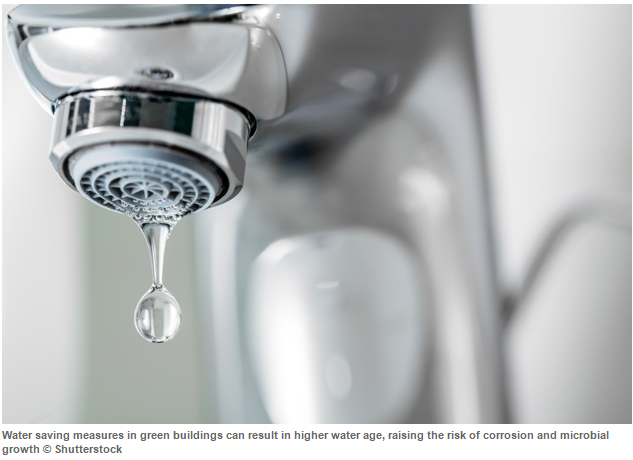
Saving water increases health risks in green buildings

US researchers have found that strategies for conserving water in green buildings can lead to higher levels of bacteria in the plumbing systems, with potentially serious implications for public health.
William Rhoads and colleagues at Virginia Tech conducted a survey of the drinking water quality in different types of green building, from an office to a net-zero energy home. They measured the chlorine levels, temperature and microbial content, including the prevalence of Legionella bacteria, the cause of Legionnaires’ disease. They found that chlorine disinfectant decays up to 144 times faster in green systems due to high water age. Rhoads feels that their study is important in the current construction market. ‘We are at the beginning of a green building revolution where new products and approaches to water and energy conservation are coming to the market much faster than we can critically evaluate their impact.’ The US Green Building Council estimated that 40–48% of new non-residential buildings would be classified as green by 2015, and water saving measures are now being widely adopted. These include low-flow water fixtures, which use high pressure techniques to produce a strong flow with less water. As a result, drinking water is sitting in green buildings for longer than in traditional constructions, risking problems with corrosion, unappealing taste and microbial growth.
Project director of The Enterprise Centre at the University of East Anglia, the UK’s greenest commercial building, agrees that swift action is needed: ‘This research provides a very valuable set of findings about the impact of water age in green buildings and as such the green and eco-building industry needs to address these findings as a priority.’
UK-based independent consultant in drinking water research and analysis Mark Smith describes the report as ‘thought provoking’, but warns that the techniques may not be universal. ‘The study emphasises chlorine residuals within building water distribution systems. Care must be taken as these residuals are normal for American systems but are much higher than those encountered in the UK and other countries.’
Rhoads tells Chemistry World that many unknowns remain. ‘This study is meant to highlight the scientific understanding that we do have relative to public health, and to point out just some of the data gaps that still exist.’

Survey of green building water systems reveals elevated water age and water quality concerns

Environ. Sci.: Water Res. Technol., 2016, Advance Article

DOI: 10.1039/C5EW00221D
Received 22 Sep 2015, Accepted 05 Nov 2015
First published online 05 Nov 2015

http://pubs.rsc.org/en/Content/ArticleLanding/2016/EW/C5EW00221D#!divAbstract

24 de nov. de 2015

Uma bactéria que mata cinco mil brasileiros por ano = LEGIONELLA

Por Roxana Tabakman em 23/11/2015 na edição 877

Habituados a noticiar desgraças, nós jornalistas logo procuramos responsabilidades entre os causadores de tragédias por ação ou omissão. Geralmente os holofotes estão no terrorismo, no governo, nas empresas. Poucas vezes olhamos para atrás, e nos perguntamos o quê a imprensa poderia ter feito.
Agora, alertam os especialistas, a população brasileira corre um sério risco pela falta de divulgação na grande mídia de uma ameaça chamada Legionella, uma bactéria que, segundo estimativas, já mata anualmente cerca de 5.000 brasileiros.
“A imprensa trata do assunto com pouca ênfase e quando o aborda confunde informações” reclama o especialista em risco Leonardo Cozac. Semanas atrás, por exemplo, a TV Globo fez umamatéria sobre a Legionella que chamou a atenção dos especialistas por ter fornecido informações incompletas. “Nela se falava de que a Legionella vem pelo ar condicionado e de que o risco está somente na água aquecida” explicou ao Observatório da Imprensa, Marcos d’Avila Bensoussan, outro especialista da área que logo depois da emissão do programa fez o alerta do erro pelas redes sociais.
Bactérias da Legionella no microscópio / Foto Wikimedia - CC
Bactérias da Legionella no microscópio / Foto Wikimedia – CC
O perigo oculto no lava-jato
“As reportagens devem sempre consultar pesquisadores” recomenda Bensoussan, que acrescentou: “a imprensa tem que tomar cuidado.” Contrariamente ao difundido, a bactéria pode estar em qualquer aerossol ou vapor de agua, e na lista preta entram chuveiros, fontes decorativas, jacuzzis, parques aquáticos, umidificadores de ar, torres de resfriamento utilizados na refrigeração e máquinas de lava-jato.
Os especialistas não se cansam de afirmar que no ano de 2013, quando no Brasil ocorreram 387 mortes por dengue, 4.600 por tuberculose e 41 de malária, pela “desconhecida” Legionella teriam morto em torno de cinco mil pessoas. Os idosos com problemas respiratórios e fumantes formam o maior grupo de risco. Mortes, custos médicos, absenteísmo em escolas e trabalho poderiam diminuir sensivelmente com mais informação. A única prevenção possível é evitar a sua proliferação nos ductos de água. Infelizmente, análises de amostras de água de todo o Brasil, mostram um percentual de 15% de resultados positivos para a bactéria.
Uma busca no Google, permite conferir facilmente o pouco destaque que a mídia brasileira tem dado ao problema que acaba com 13 vidas por dia no país, nos cálculos mas otimistas. A imprensa pode colaborar de diversas maneiras. Uma é simplesmente publicando notícias que atraiam a atenção do público e dos responsáveis. Em tese, a difusão de informações sobre a legionella poderia fazer pressão para que o Ministério da Saúde aborde o assunto de forma proporcional à sua importância. Os hospitais no Brasil não identificam o tipo de microrganismos que causa febre ou pneumonia, e se fosse feita a identificação, seria mais fácil localizar surtos ou regiões com problemas de proliferação da bactéria.
Fatos noticiosos a destacar não faltam. Em Nova Iorque houve um surto recente com cerca de 12 mortes e mais de 300 pessoas contaminadas. Houve casos fatais também em Illinois e Califórnia. De fato, nos EUA os casos se triplicaram entre 2001 e 2012. Faz um ano houve no Portugal um surto com 7 mortes e 273 contaminados.
A grande maioria dos focos da doença está associada a hotéis, resorts, e navios além de hospitais e por causa disso o assunto está despertando o interesse dos turistas estadounidenses que virão aos Jogos Olímpicos. Quando se fala em Legionella no Brasil, logo vem à cabeça de muitos, o caso do ex-Ministro Sérgio Motta, que teria falecido depois de ter contraído essa bactéria. Na época, o governo e a mídia relacionaram essa morte a sistemas de ar condicionado sem manutenção. A qualidade de ar melhorou, mas o risco ainda se esconde no água.
Uma segunda via em que a mídia e chamada a ocupar um papel importante é alertar corretamente sobre a prevenção da enfermidade, explicando de forma clara os cuidados domésticos como a esterilização da água utilizada em umidificadores residenciais e a limpeza de chuveiros. “A Legionella ficou conhecida em 1976. Já se passaram quarenta anos, os casos se multiplicam e ainda há muito por fazer para que mais vidas sejam poupadas por esta bactéria no nosso dia a dia” conclui Bensoussan, editor do livro gratuito de divulgação Legionella na visão de especialistas. “A população brasileira corre um sério risco pela falta de divulgação na grande mídia e por falta de interesse do Ministério da Saúde em abordar seriamente o assunto.” acrescenta Cozac.
Problemas no pais não faltam. Seria bom não ter que agregar ao dengue, vírus Zika e microcefalia, o título “Surto de Legionella no Brasil”. Ainda dá para fazer a nossa parte. Para mais detalhes sobre a Legionella, visite as seguintes páginas na internet:
***
Roxana Tabakman é bióloga e jornalista. Autora do livro “A saúde na mídia. Medicina para jornalistas, jornalismo para médicos” (Ed. Summus).